Crossing the Jordan: Remembering God’s Faithfulness, Embracing God’s Future
Scripture: Joshua 3–4; Isaiah 43:1–19
Central Truth: Remembering God’s faithfulness in the past gives us courage to follow him into the future.
Standing at the River
There are times in life when we find ourselves standing between the past we know and a future we cannot see.
Behind us are memories, accomplishments, disappointments, and experiences that have shaped who we are.
Ahead of us are possibilities, uncertainties, and perhaps a few things that frighten us.
That is where the Israelites found themselves in Joshua 3.
Forty years earlier, God had delivered them from generations of slavery in Egypt. He brought them through the Red Sea and led them toward the land he had promised Abraham.
But because of unbelief and rebellion, that first generation never entered the Promised Land.
Instead, Israel spent forty years wandering in the wilderness.
No permanent homes. No settled homeland. No milk and honey.
And now Moses was dead.
A new generation stood on the banks of the Jordan River, looking toward the land God had promised their ancestors.
Joshua had been appointed to lead them.
On the other side was their future.
But there was a problem.
A river stood between them and God’s promise.
And not just any river. Joshua tells us that the Jordan was at flood stage.
There was no bridge, no ferry, and no obvious way for an entire nation—including children, livestock, and possessions—to cross.
What were they going to do?
When God Makes a Way
God gave Joshua some rather unusual instructions.
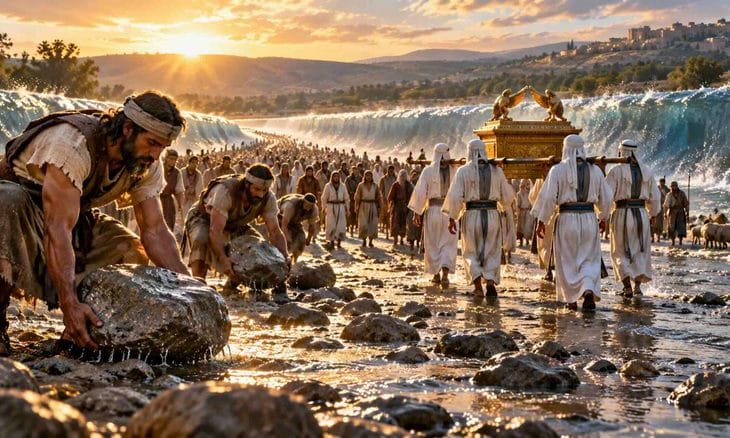
The priests were to carry the Ark of the Covenant, the sacred symbol of God’s presence among his people, and walk toward the river.
The people were to follow.
And when the priests reached the water, they were to step into it.
Now, notice what happened.
The river didn’t stop flowing while the priests were standing safely on the bank.
The water stopped when the priests stepped into the river.
Joshua 3 tells us that as soon as their feet touched the water, the river stopped flowing upstream.
The priests carried the Ark into the riverbed and stood there while the entire nation crossed on dry ground.
This was no ordinary event.
It was an act of God.
And there was something wonderfully familiar about it.
Forty years earlier, God had opened the Red Sea so their parents could escape Egypt.
Now God opened the Jordan River so their children could enter the Promised Land.
The God who had been faithful to Moses’ generation was still faithful to Joshua’s generation.
But God wasn’t finished.
Twelve Stones and a Story Worth Remembering
While the priests were still standing in the riverbed, God told Joshua to select twelve men, one from each tribe of Israel.
Each man was to pick up a stone from the middle of the Jordan and carry it to the place where Israel would camp that night.
There, at Gilgal, Joshua arranged the twelve stones as a memorial.
Why?
Because God knew something about human nature.
We have remarkably short memories when it comes to God’s faithfulness.
Joshua explained that someday their children would see those stones and ask:
“What do these stones mean?”
And when that happened, the Israelites were to tell the story.
They were to tell their children how God had stopped the Jordan River so the nation could cross on dry ground.
Those stones would remind future generations that God had made a way when there seemed to be no way.
And they would need that reminder.
There would be difficult days ahead.
There would be battles they could not win by themselves.
There would be new challenges, new enemies, and new uncertainties.
And when those moments came, the stones would remind them:
We’ve been here before.
We’ve faced the impossible before.
And God made a way.
Once everyone had crossed, the priests carrying the Ark came out of the river.
And the floodwaters returned.
The crossing was complete.
Israel had entered the Promised Land.
Joshua explained the larger purpose of this miracle:
“He did this so all the nations of the earth might know that the LORD’s hand is powerful, and so you might fear the LORD your God forever.”
— Joshua 4:24, NLT
Those twelve stones told a simple story.
God had delivered his people from slavery.
God had kept his promises.
God had remained faithful.
Remember that!
But here is something equally important.
Those stones were not an invitation to go backward.
God didn’t tell Israel to return to the wilderness.
He didn’t tell them to go back to Egypt, where at least life had been familiar.
He didn’t tell them to rebuild the past.
The stones were there to remind Israel that the God who had brought them this far could be trusted with whatever came next.
And that brings us to another remarkable passage of Scripture.
Isaiah 43: Remember the Past, but Don’t Live There
Several centuries after Joshua, the people of Judah faced another crisis.
In 586 BC, Jerusalem fell to the Babylonians.
The Temple was destroyed. The city was burned. Many of the people were carried into exile.
For the people of God, this was more than a political catastrophe.
It raised some frightening spiritual questions.
Had God abandoned them?
Were they still his people?
Had their sins finally caused God to give up on them?
Would they ever go home?
Isaiah 43 speaks directly to those fears.
Whether we understand the passage as Isaiah’s earlier prophetic announcement of the exile and restoration or as a message proclaimed during the exile, its promise addresses a people who have lost almost everything familiar.
Listen to God’s words:
“Do not be afraid, for I have ransomed you. I have called you by name; you are mine.”
— Isaiah 43:1, NLT
Think about that.
They had lost their land.
They had lost their city.
They had lost their Temple.
They had lost their national security.
But they had not ceased to belong to God.
And then God reminds them of his faithfulness:
“When you go through deep waters, I will be with you. When you go through rivers of difficulty, you will not drown.”
— Isaiah 43:2, NLT
Does that sound familiar?
It should.
God is deliberately recalling the great deliverances of Israel’s history.
The Red Sea.
The Jordan River.
The God who had made a way through the waters was still their God.
But then comes an extraordinary statement.
In Isaiah 43:18–19, God says:
“But forget all that—it is nothing compared to what I am going to do. For I am about to do something new.”
— Isaiah 43:18–19, NLT
Wait a minute!
Didn’t God tell Joshua to build a memorial so Israel would remember?
And now God says to forget the former things?
Isn’t that a contradiction?
Not at all.
God is telling his people something very important.
Remember what I have done, but don’t assume that what I did before is the only thing I can do now.
The God who made a path through the sea could also make a road through the wilderness.
The God who delivered Israel from Egypt could deliver his people from Babylon.
And the God who had been faithful in the past could be trusted with a future they had not yet imagined.
In 539 BC, Cyrus of Persia conquered Babylon. His policies subsequently opened the way for Jewish exiles to return to their homeland.
The promise of restoration was beginning to take historical shape.
But the larger lesson reaches beyond that particular moment in Israel’s history.
God’s faithfulness does not change.
The circumstances in which we experience that faithfulness often do.
Three Things We Need to Remember
So how do we apply these passages to our own lives?
Let me suggest three things.
1. Remember who you are.
God told Israel:
“I have called you by name; you are mine.”
Perhaps you sometimes wonder whether you are worthy of God’s attention.
Perhaps you think you have failed too often.
Perhaps you believe your faith is too weak, your mistakes too numerous, or your opportunities too limited.
But the good news of Jesus Christ is that our relationship with God rests upon his grace, not our accomplishments.
In Christ, we are redeemed.
We are forgiven.
We are adopted into God’s family.
We are made new.
As Paul tells us in 2 Corinthians 5:17, anyone who belongs to Christ has become a new person.
So remember who you are.
God does!
2. Remember who God has been.
Think about the times God has made himself known to you.
The times he rescued you.
The times he provided what you needed.
The times he carried you through grief, disappointment, or uncertainty.
The times you couldn’t see a way forward, but somehow a way opened.
And above all, remember the day you came to know Jesus Christ.
Remember his forgiveness.
Remember his grace.
Remember the new life he gave you.
Those are your memorial stones.
They remind you that the God who has been faithful before can still be trusted.
3. Expect God to act again.
In Isaiah 43:19, God asks:
“See, I have already begun! Do you not see it?”
That’s an important question.
Sometimes we are so busy looking backward that we fail to recognize what God is doing right in front of us.
Sometimes we expect God to repeat yesterday’s methods when he is preparing tomorrow’s opportunities.
And sometimes the greatest obstacle to embracing God’s future is our attachment to the familiar past.
That doesn’t mean the past was bad.
It doesn’t mean our traditions are worthless.
And it certainly doesn’t mean we should forget the people whose faithfulness brought us to where we are today.
It means that the purpose of remembering the past is to strengthen our faith for the future—not to keep us living in the past.
What Does This Mean for Forest Meadow?
Now, let’s bring this a little closer to home.
Forest Meadow has its own collection of memorial stones.
Some of you remember when this congregation began in 1972, meeting in the living room of Bob and Mary Ellen Paramore.
That small group had emerged from a disagreement about the direction of ministry at Gaston Avenue Baptist Church.
They believed God was calling them to something different.
And so they stepped into the river.
From approximately twenty people, the congregation grew to around 450 in just three years.
Many people came to faith in Christ and were baptized.
Eventually, the congregation purchased this property and built this building in 1979.
Those were exciting years.
But not every memory is a happy one.
Conflict divided the congregation.
Membership declined dramatically.
And over the years, the church experienced the kinds of struggles that many older congregations know all too well.
But that is not the whole story.
Remember the mission trips?
Europe. Cape Cod. New Zealand. South Sudan. And other places around the world.
Remember the people who came to know Christ because someone from Forest Meadow shared the gospel?
Remember the Vacation Bible Schools?
Some of you may even remember the year the church built a parade float featuring a life-sized elephant and hauled it down Church Road to promote Vacation Bible School!
Now, that’s creativity!
And remember how this congregation made the difficult decision to sell part of its property so that the building could be renovated and ministry could continue.
Those are memorial stones.
They remind us of God’s faithfulness.
But perhaps one of the most important chapters in our history is still being written.
As the Lake Highlands neighborhood changed, Forest Meadow began opening its doors and its heart to people from different ethnic and linguistic communities.
And today, seven congregations share this place we call the Churches at Forest Meadow.
Different languages.
Different cultures.
Different histories.
But one Lord Jesus Christ.
That is not simply an interesting organizational arrangement.
It is an opportunity to demonstrate the reconciling power of the gospel in a neighborhood filled with people from around the world.
And perhaps it is one of the ways God is already doing something new among us.
The Stones Are Not the Destination
Here is the question I want us to consider.
What do we do with our memorial stones?
We could gather around them and spend the rest of our lives talking about how wonderful things used to be.
We could remember the crowded classrooms, the full sanctuary, the programs, the celebrations, and the people who made those days special.
There is nothing wrong with those memories.
We ought to preserve them.
We ought to tell those stories to our children and grandchildren.
But Israel didn’t cross the Jordan so they could build a monument and spend the rest of their lives admiring it.
They crossed the Jordan because God was leading them somewhere.
The memorial stones were reminders of God’s faithfulness, not substitutes for following him.
And the same is true for us.
Our calling is not to recreate Forest Meadow as it existed in 1979.
Our calling is to be faithful to Jesus Christ in 2026 and beyond.
The gospel has not changed.
The command to love God and love our neighbors has not changed.
The Great Commission has not changed.
But the neighborhood has changed.
The world has changed.
And the opportunities for ministry have changed.
So perhaps we need to ask some new questions.
Which memories should we preserve and tell?
What spiritual fruit did God produce through the ministries of earlier generations?
Which forms of ministry have completed their purpose?
What new forms might carry the same unchanging gospel to our neighbors today?
And where might God already be making a road that we have not recognized?
These are not questions we can answer in a single sermon.
They are questions we need to explore together, prayerfully and honestly.
Conclusion: The God Who Made a Way
I want to leave you with one final thought.
When Israel stood at the Jordan River, the people could see the obstacle.
They could see the floodwaters.
They could see the uncertainty.
What they could not yet see was the dry ground beneath the river.
But God could.
And when the priests stepped forward in obedience, God made a way.
Centuries later, when the people of Judah were living in exile, they could see everything they had lost.
What they could not see was the road home.
But God could.
And when God promised to do something new, he was calling them to trust the same faithfulness they had known throughout their history.
Perhaps we find ourselves standing at a similar place.
We can see the changes around us.
We can see the challenges.
We can see the things that are no longer what they used to be.
But we cannot yet see everything God may have prepared for us.
And that is where faith comes in.
Faith does not require us to forget the past.
Faith invites us to remember God’s faithfulness—and then follow him into the future.
So let’s gather our memorial stones.
Let’s tell the stories.
Let’s give thanks for those who came before us.
But let’s not build our homes around the monuments.
The God who brought us this far is not finished with us yet.
And the God who made a way through the Red Sea, who opened the Jordan River, and who brought his people home from exile is still worthy of our trust.
The question is not whether we can recreate the good old days.
The question is whether we will recognize and follow God’s leading in the days ahead.
Remember what God has done.
Trust who God is.
And be ready for what God may do next.
Amen.
Scripture quotations are from the Holy Bible, New Living Translation (NLT).